
About Us
- About Us
A Place Where You Can Be Heard, Understood, and Supported
At What’s On Your Mind? Behavioral Health, we believe meaningful mental-health care begins with listening. Our practice was founded on a simple but important question: “What’s on your mind?”
We provide compassionate, evidence-based psychiatric care for children and adults in a welcoming, judgment-free environment where patients and families can feel comfortable sharing what they are experiencing. Our approach is centered on understanding each person as an individual and working collaboratively toward greater stability, wellness, and quality of life.
Founded by Dr. Raysene Hall, DNP, PMHNP-BC, our practice brings experience in caring for individuals with a wide range of psychiatric and behavioral-health concerns, including depression, anxiety, PTSD, bipolar disorder, ADHD, schizophrenia, serious mental illness, substance-use disorders, and crisis psychiatric conditions.
Whether you are seeking care for yourself or your child, an initial psychiatric evaluation, medication management, or ongoing behavioral-health support, our goal is to provide care that is personalized, compassionate, and grounded in evidence.

Listen
We take the time to understand what you're experiencing, what concerns you most, and what you want from your care.
Understand
Your symptoms, experiences, circumstances, and goals all provide important context. We look beyond a single symptom or diagnosis.
Collaborate
Mental-health care works best when patients are active participants in their treatment. We work together to develop an approach that fits your individual needs.
Support
Whether you're beginning care or continuing treatment, we provide ongoing psychiatric support focused on your well-being and progress.

- Meet Provider
Dr. Raysene Hall, DNP, PMHNP-BC Founder & CEO
Psychiatric Mental Health Nurse Practitioner
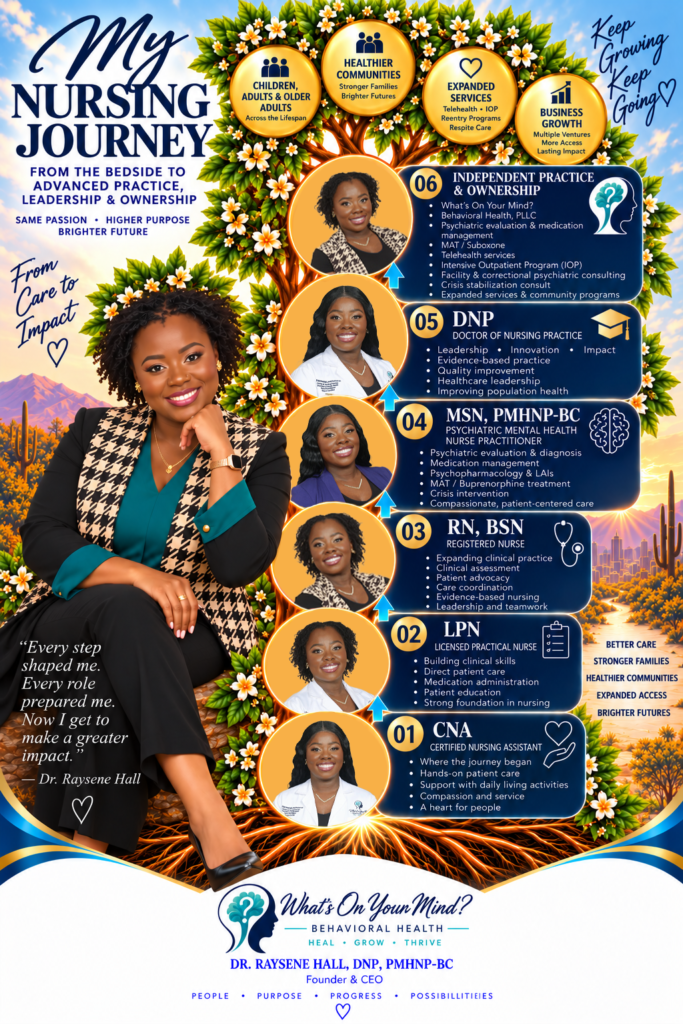
Dr. Raysene Hall is a board-certified Psychiatric Mental Health Nurse Practitioner and Doctor of Nursing Practice with a healthcare career built from the ground up. Her journey through nursing has included practice as a Certified Nursing Assistant (CNA), Licensed Practical Nurse (LPN), Registered Nurse (RN), and ultimately a Psychiatric Mental Health Nurse Practitioner (PMHNP-BC). This progression has provided her with a unique understanding of patient care across multiple levels of the healthcare system.
Dr. Hall earned her Bachelor of Science in Nursing from the University of Phoenix, Master of Science in Nursing with specialization as a Psychiatric Mental Health Nurse Practitioner from Walden University, and Doctor of Nursing Practice from Walden University.
Her clinical background includes outpatient and inpatient psychiatry, psychiatric crisis stabilization, correctional mental health, severe mental illness, substance-use treatment, medication-assisted treatment, and high-acuity behavioral healthcare. She has extensive experience evaluating and treating individuals experiencing depression, anxiety, trauma-related disorders, bipolar disorder, schizophrenia and other psychotic disorders, substance-use disorders, suicidal crises, and complex co-occurring psychiatric conditions.
Before entering advanced psychiatric practice, Dr. Hall worked in crisis and inpatient psychiatric settings, providing psychiatric nursing care, stabilization, detoxification monitoring, interdisciplinary treatment planning, and discharge coordination. Her advanced-practice experience includes comprehensive psychiatric evaluations, DSM-5-TR diagnostic assessment, individualized treatment planning, psychopharmacology, medication management, long-acting injectable medications, MAT/buprenorphine treatment, suicide-risk assessment, and psychiatric crisis intervention.
Her approach to mental healthcare is compassionate, patient-centered, trauma-informed, and evidence-based. She believes effective psychiatric care begins with listening—not simply identifying symptoms. Patients should have an opportunity to understand what they are experiencing, participate meaningfully in treatment decisions, and receive care that considers the person behind the diagnosis.
That philosophy inspired the creation of What’s On Your Mind? Behavioral Health.
The name begins with a simple but important question:
“What’s on your mind?”
Dr. Hall created the practice to provide a space where individuals can speak openly about their experiences without feeling dismissed, rushed, or judged. Treatment is collaborative and individualized, with the goal of helping patients achieve greater stability, healing, personal growth, and quality of life.
Her clinical philosophy reflects the mission of the practice:
HEAL • GROW • THRIVE
How to Get Started
Step 1
Fill out our short intake form with your details.
Step 2
Select insurance or private pay. We’re in-network with most major insurance plans.
Step 3
Choose a day and time that works best for you.
Step 4
Meet your psych NP using a secure video link.
Mission:
Vision:
Purpose:
Our Promise:
Our Motto:


How we care for you?
- Comprehensive psychiatric Assessment & Documentation
- DSM-5-TR diagnosis and coding
- Differential diagnosis development and rule out/elimination
- Medical and psychiatric diagnostic workup
- Medication selection and dosing
- Psychotherapy and nonpharmacologic interventions
- Individualized treatment planning
- Suicide, violence, overdose, withdrawal, and other safety considerations
- Appropriate level-of-care decisions
- Medication monitoring and follow-up
- Patient and family education
- Care coordination